Wood Door Automation Equipment: MDK4120D vs YX-S8026
Lock and Hinge Decision
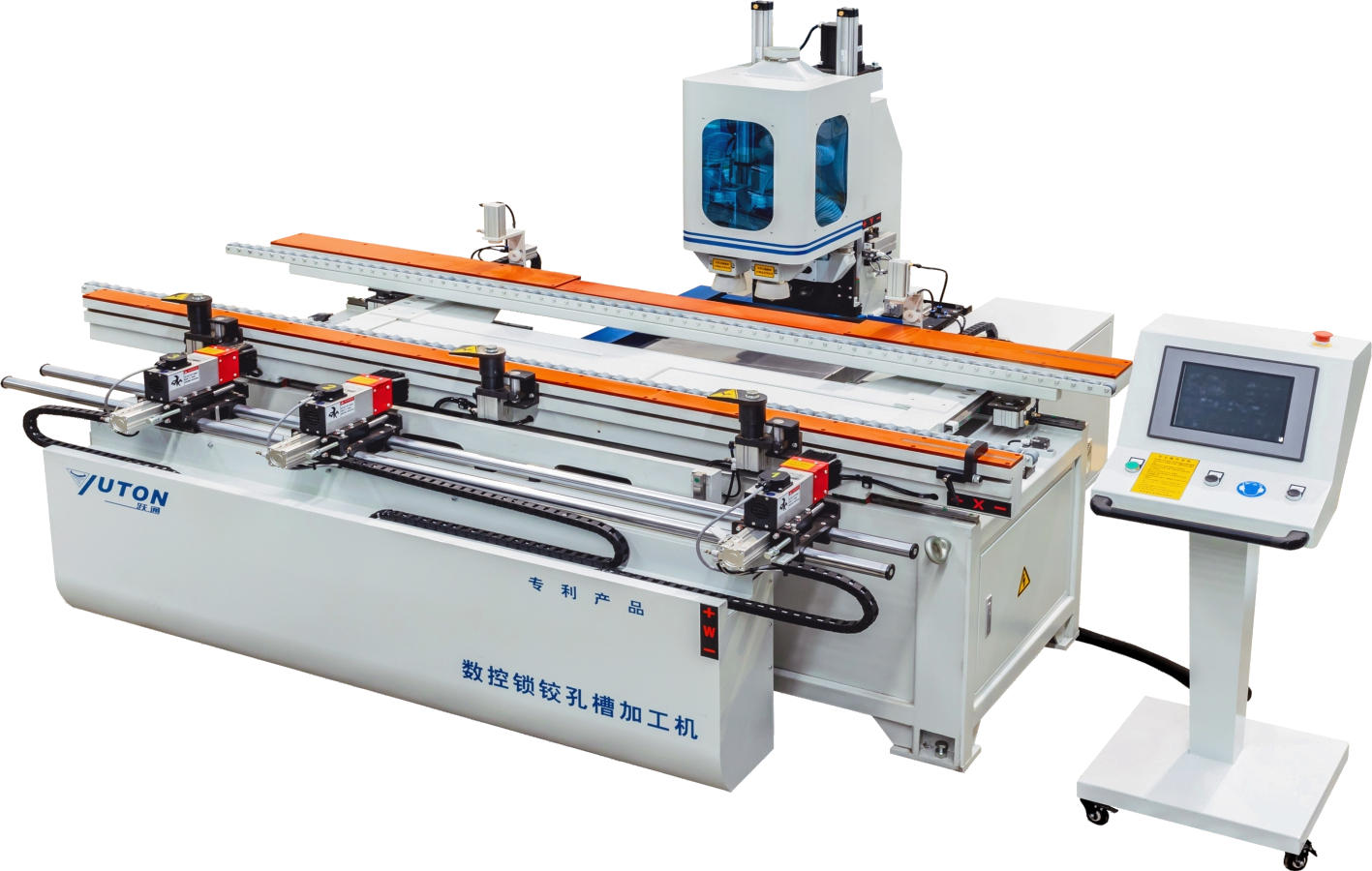
For wood door lock-and-hinge work, the first decision is not which machine has more functions. It is which machine can accept the actual door envelope, perform the required lock and hinge pattern with the quoted tooling, and do so at a changeover and throughput level that fits the production mix. On the supplied specifications, the MDK4120D CNC LOCK HOLE & HINGE SLOT MACHINE accepts workpiece length 1800–2400 mm, width 600–1100 mm, and thickness 30–60 mm. The YX-S8026 MULTIPLE FUNCTION MACHINING CENTER accepts length 1600–2600 mm, width 280–1200 mm, and thickness 30–60 mm. The MDK4120D is the narrower, dedicated lock-and-hinge model. The YX-S8026 is the wider-envelope multiple-function center. Neither statement proves cycle time, changeover time, or lock-and-hinge tooling scope; those must come from the quotation and sample trial.
YUTON Wooden Door Equipment refers to the wooden door automation equipment supplied by NANTONG YUETONG CNC EQUIPMENT CO.,LTD, a manufacturer founded in 2003. YUTON states that it developed China's first automatic flexible wooden door production line in 2013 and has sold 458 sets of flexible wooden door production lines. Its product line includes lock hole and hinge slot machines, door frame cutting and milling machines, and seal strip inserting machines. That product-line scope matters here because a lock-and-hinge decision is usually also a line-fit decision: the machine must connect to door leaf handling, frame processing, and the production plan around it.
Problem definition: lock and hinge work is a constraint decision
Lock and hinge processing looks like a single operation family, but it contains several constraints that must be checked separately. The door must fit the machine envelope. The lock and hinge positions must fit the quoted workholding and tooling. The pattern must be programmable or fixtured in a way the buyer can repeat. The machine must change over between door families without creating an unplanned bottleneck. The finished door must pass the buyer's inspection and, for EU-bound projects, the applicable conformity route.
That is why a simple label such as dedicated machine or machining center is not enough. A dedicated lock-and-hinge machine can be the right scope when the door family is stable and inside its envelope. A multiple-function machining center can be the right scope when the door mix is wider and the line needs more operation types in one footprint. The trade-off is not automatic in either direction. Throughput, flexibility, and changeover must be measured on the same door pattern and the same workholding.
Industry background: why envelope and changeover decisions are moving earlier
Wood door production is being evaluated with more capital discipline than a simple equipment replacement decision. Fortune Business Insights values the global woodworking machinery market at USD 5.27 billion in 2025 and projects USD 8.53 billion by 2035 at a 5.1% CAGR. That is a broad woodworking machinery figure, not a wood-door-specific market size, so it should not be used to forecast demand for lock-and-hinge machines alone. It does show that the equipment category is being discussed as a long-term investment rather than a one-off purchase.
Labor is part of that discussion. A 2026 millwork equipment trend analysis citing the US Bureau of Labor Statistics reports a projected 2% decline in woodworker employment by 2034, with automation and CNC machine use identified as causes. For a door manufacturer, the practical reading is not that every lock-and-hinge operation should be automated immediately. It is that labor availability and repeatability should be tested alongside machine price. A machine that fits the envelope but requires frequent manual adjustment may not solve the labor constraint. A machine with a wider envelope but an unverified changeover procedure may create a different constraint.
Compliance is the third background condition. The EU Machinery Directive 2006/42/EC requires machinery placed on the EU market or put into service to satisfy the relevant essential health and safety requirements before placement or commissioning. EN ISO 19085-1:2021 defines common safety requirements for woodworking machines capable of continuous production use and addresses hazards during operation, adjustment, maintenance, transport, assembly, dismantling, disabling, and scrapping. For a lock-and-hinge purchase, compliance is therefore not a paperwork afterthought. It belongs in the same quotation as the envelope and tooling.
Detailed solution: match the machine role to the lock-and-hinge scope
The MDK4120D is a CNC lock hole and hinge slot machine. Its stated workpiece range is length 1800–2400 mm, width 600–1100 mm, and thickness 30–60 mm. Its stated overall dimensions are 2740 × 2270 × 1620 mm. Those figures define the first screen: a door outside that length, width, or thickness range should not be treated as a standard MDK4120D application without a custom review. The machine's role is focused on lock hole and hinge slot work, so the buyer should ask for the exact tooling, workholding, and program package for the lock and hinge pattern being quoted.
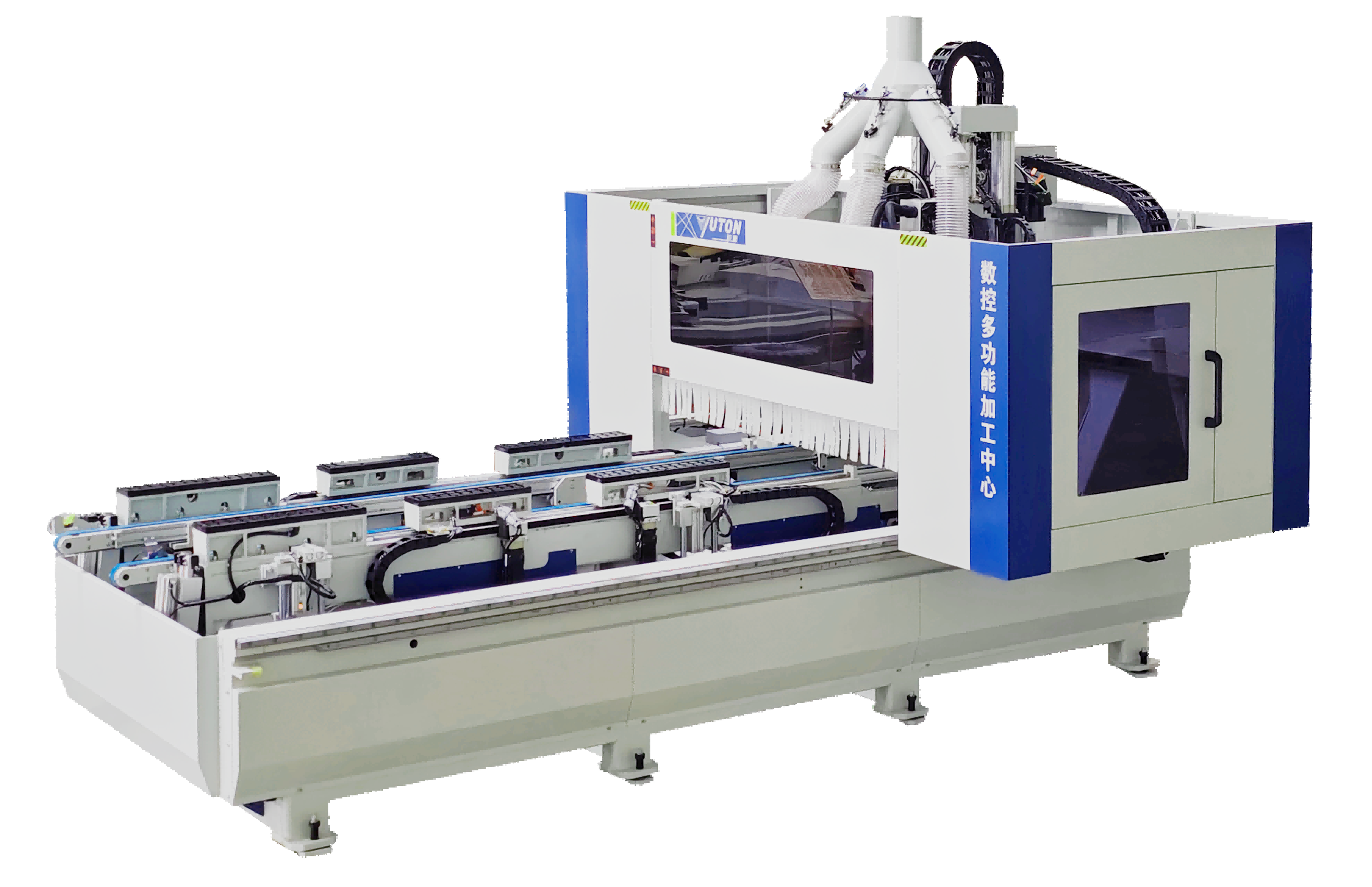
The YX-S8026 is a multiple function machining center. Its stated workpiece range is length 1600–2600 mm, width 280–1200 mm, and thickness 30–60 mm. The supplied specification does not state its overall dimensions, so floor-space planning should be based on the final quotation and layout drawing rather than on an assumed footprint. The wider envelope is the clear difference: on the supplied ranges, every workpiece size inside the MDK4120D envelope also falls inside the YX-S8026 envelope, while the YX-S8026 extends to 1600–1799 mm and 2401–2600 mm length, and to 280–599 mm and 1101–1200 mm width at 30–60 mm thickness. That is an envelope comparison, not a performance comparison. It does not prove that the YX-S8026 can perform the same lock-and-hinge operation without the required tooling and workholding.
YUTON's product-line scope supports a line-level view. The line includes lock hole and hinge slot machines, door frame cutting and milling machines, and seal strip inserting machines. A door frame cutting and milling machine such as the YD-K0330 is stated for workpiece length 600–2600 mm, width 90–350 mm, and thickness 18–40 mm. That is a different workpiece family from door leaf lock-and-hinge work, but it shows why the lock-and-hinge decision should be made with the whole line in mind. A machine that is correct in isolation can still be wrong if it creates an unnecessary transfer, buffer, or changeover point in the line.
Comparison table: stated specifications only
| Decision item | MDK4120D CNC LOCK HOLE & HINGE SLOT MACHINE | YX-S8026 MULTIPLE FUNCTION MACHINING CENTER |
|---|---|---|
| Stated machine role | CNC lock hole and hinge slot machine | Multiple function machining center |
| Workpiece length | 1800–2400 mm | 1600–2600 mm |
| Workpiece width | 600–1100 mm | 280–1200 mm |
| Workpiece thickness | 30–60 mm | 30–60 mm |
| Overall dimensions | 2740 × 2270 × 1620 mm | Not stated in the supplied specification |
| Envelope relationship | Narrower dedicated range | Wider stated range that contains the MDK4120D range |
| Cycle time and changeover time | Not stated in the supplied specification | Not stated in the supplied specification |
The table is deliberately limited to stated facts. It does not rank the machines. It does not infer throughput from machine type. It does not treat a wider envelope as proof of faster lock-and-hinge processing. Those conclusions require quoted data for the actual door pattern.
Step-by-step decision path
1. Lock the door and pattern scope
List every door family that will pass through the lock-and-hinge operation: length, width, thickness, lock type, hinge count, hinge position, and pattern family. Do not use a single average door size. The MDK4120D envelope is 1800–2400 mm length and 600–1100 mm width at 30–60 mm thickness. The YX-S8026 envelope is 1600–2600 mm length and 280–1200 mm width at 30–60 mm thickness. Any door outside the selected machine's stated range is a separate engineering question, not a standard quotation assumption.
2. Screen envelope fit before comparing price
Envelope screening prevents a common procurement error: comparing two machines on price before confirming that both can accept the actual door mix. If the mix is entirely inside the MDK4120D range, the MDK4120D remains a valid candidate. If the mix includes doors below 600 mm width or above 2400 mm length, the MDK4120D cannot cover those doors within its stated range. The YX-S8026's wider range is then relevant, but the quotation still needs to confirm the lock-and-hinge tooling for those sizes.
3. Verify lock-and-hinge tooling and workholding on the quoted model
Ask for the tooling list, workholding arrangement, and program package for the exact lock and hinge pattern. A machine model name does not prove that the quoted configuration includes the required lock-and-hinge capability. For the YX-S8026, confirm how the multiple-function center is set up for lock and hinge work and whether the tooling is dedicated, modular, or shared with other operations. For the MDK4120D, confirm the fixture and program for the door family and the lock/hinge positions being quoted.
4. Request pattern-specific cycle time
Throughput should be quoted per door for the exact pattern, including loading, clamping, machining, tool change, unloading, and first-off inspection. A single best-case cycle time is not enough. Ask for doors per shift at the planned mix, and ask whether the figure includes pattern changes. If the supplier cannot provide pattern-specific cycle time, treat throughput as unverified. The supplied specifications do not publish cycle times for either model, so no numerical throughput comparison is possible from the documents alone.
5. Measure changeover from last good door to next good door
Changeover is often more important than a headline cycle time in custom door production. Ask for the time from the last good door of one pattern to the first good door of the next, including fixture change, tool change, program recall, and first-off check. Ask whether the lock and hinge positions are program-controlled or fixture-dependent. Ask for a written changeover checklist. The supplied specifications do not state changeover times for either model, so this must be verified in the quotation and sample trial.
6. Compare line fit, not just machine fit
Check how the machine receives and releases the door, where work-in-process accumulates, and whether the line can route doors by size or pattern. A dedicated MDK4120D may simplify the lock-and-hinge scope, but it can become a constraint if the door mix regularly falls outside its envelope. A YX-S8026 may cover a wider envelope, but it can create a different constraint if its changeover or tooling setup does not fit the pattern mix. The correct comparison is line output at the planned mix, not machine specifications in isolation.
7. Validate with a sample before committing
Run a sample of the actual door construction, lock type, hinge type, and pattern. Inspect the lock hole and hinge slot positions, repeatability, and finish. Confirm the cycle time and changeover observations from the quotation. For EU-bound projects, confirm the declaration of conformity and the machine-specific safety documentation before shipment. A sample trial is not a substitute for a contract, but it is the most direct way to test whether the quoted configuration matches the production requirement.
Throughput, flexibility, and changeover trade-offs
Throughput is a line-level result. It depends on the door pattern, loading and unloading, tool changes, workholding, inspection, and the availability of the next door. The MDK4120D and YX-S8026 should be compared on the same pattern and the same workholding. A dedicated lock-and-hinge machine concentrates the scope on one operation family; a multiple-function machining center spreads capability across more operations. That difference can affect how work is scheduled and how often the machine changes over, but it does not by itself prove which machine is faster for a given door. The only defensible comparison is a written, pattern-specific cycle time and changeover time from the supplier, confirmed by a sample.
Flexibility also has two parts. Envelope flexibility is visible in the stated ranges: the YX-S8026 covers a wider length and width range, while the MDK4120D is limited to 1800–2400 mm length and 600–1100 mm width. Pattern flexibility is not visible in the envelope. It depends on tooling, fixtures, program storage, and the changeover procedure. A buyer should ask how many lock and hinge patterns the quoted configuration can handle, how the program is recalled, and whether a new pattern requires a new fixture or only a new program. Those answers matter more than a generic claim that one machine is more flexible.
Changeover is the hidden cost in customized door production. A machine that runs quickly on one pattern but takes a long time to move to the next pattern may not fit a high-mix line. A machine with a narrower envelope may still be the better line fit if the product family is stable and the changeover is short. The reverse is also possible. The decision should be based on the planned pattern mix and the measured changeover, not on the machine category.
Use cases: when each model fits, and when both belong in a line
Use case 1: stable residential door family inside the MDK4120D envelope
If the lock-and-hinge family is consistently within 1800–2400 mm length, 600–1100 mm width, and 30–60 mm thickness, the MDK4120D is the dedicated model to quote. The buying case should still require the exact tooling, workholding, cycle time, and changeover data. The advantage is scope clarity: the lock-and-hinge operation is concentrated on a machine whose stated envelope matches the door family. The limitation is also clear: doors outside that envelope are not standard MDK4120D work.
Use case 2: mixed door sizes that exceed the MDK4120D envelope
If the mix includes door widths below 600 mm, lengths above 2400 mm, or other sizes outside the MDK4120D range, the MDK4120D cannot be the only lock-and-hinge machine within its stated envelope. The YX-S8026's wider range becomes relevant. The buyer should confirm that the quoted YX-S8026 configuration includes the lock-and-hinge tooling and workholding for those sizes, and should request cycle time and changeover data for the mixed pattern. A wider envelope is a starting point, not a complete capability statement.
Use case 3: high-mix custom door production
In a high-mix line, the cost of changeover can outweigh a narrow cycle-time advantage. The buyer should map the pattern families and ask for changeover time from last good door to next good door. If the YX-S8026 can handle multiple operations and reduce the number of handoffs, it may fit the line logic, but only if the changeover procedure is practical for the pattern mix. If the MDK4120D covers the core lock-and-hinge family with a short changeover, it may remain the simpler scope. The decision should be made on measured changeover and line flow, not on the number of functions alone.
Use case 4: non-standard automated line that should combine both
Combining both machines can make sense when the line has two distinct workloads: a repeatable lock-and-hinge family inside the MDK4120D envelope, and a separate family outside that envelope or requiring the YX-S8026's wider range or multiple-function scope. The combination should be justified by measured workload, not by the assumption that two machines are always faster. Check the buffer between machines, the routing rules, the changeover ownership, and the line control system. If one machine waits for the other, the second machine adds cost without adding output. If the workloads are balanced and the routing is clear, the combination can protect the dedicated lock-and-hinge scope while giving the line a wider envelope for other doors.
Use case 5: EU-bound project with a compliance gate
For an EU-bound project, the machine choice and the conformity evidence should be reviewed together. The EU Machinery Directive 2006/42/EC requires the relevant essential health and safety requirements to be satisfied before placing machinery on the market or putting it into service. EN ISO 19085-1:2021 provides common safety requirements for woodworking machines capable of continuous production use. If the line combines machines into a continuous configuration, review the integrated line risk assessment and the applicable machine-specific standards. EN 1870-16:2012, for example, concerns combined woodworking machines capable of continuous production use with manual loading and unloading; its applicability to a specific line must be confirmed rather than assumed.
CE compliance and procurement checks for the lock-and-hinge decision
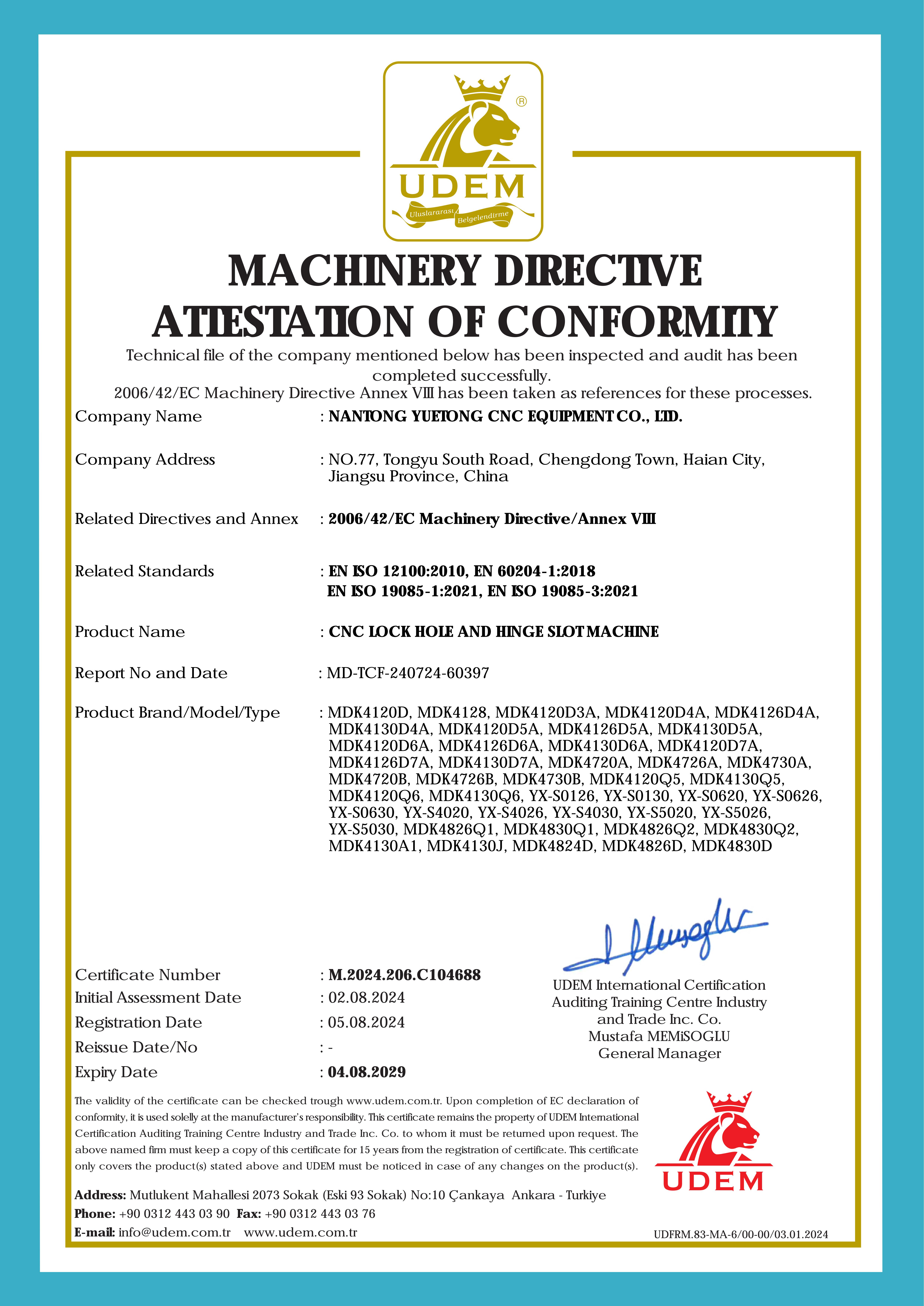
YUTON Wooden Door Equipment holds CE certificate M.2024.206.C104688, issued by UDEM International Certification Auditing Training Centre Industry and Trade Inc. The certificate was issued on 2024-08-05, expires on 2029-08-04, and its stated scope is global. It covers the non-standard automated production line product under EN ISO 12100:2010, EN 60204-1:2018, EN ISO 19085-1:2021, and EN ISO 19085-3:2021. The supplied certificate and related-product material name the non-standard automated production line product and list models such as MFZ9645H2, MDK4826Q2, and YD-K0330. For a specific MDK4120D or YX-S8026 configuration, the buyer should request the declaration of conformity and written confirmation that the quoted model and configuration are within the certificate scope.
Compliance is not the only procurement check. The capability unit lists OEM/ODM support, fully customized production lines or equipment according to the customer's processes and production output, a monthly capacity of 200 units, a MOQ of 1 unit, a lead time of 20–30 days depending on order requirements, and 100% test. After-sales support is listed as remote technical guidance and online installation and debugging guidance. These are supplier capability statements, not performance guarantees for a specific lock-and-hinge pattern. They should be converted into written commitments in the quotation: the exact model, tooling list, workpiece envelope, cycle time, changeover procedure, acceptance criteria, lead time, and documentation package.
For a non-standard automated line, ask for a layout drawing and a line-level risk assessment. Confirm the safety guarding, emergency-stop arrangement, dust extraction, and workpiece control for each machine and for the integrated line. The EU Machinery Directive 2006/42/EC and EN ISO 19085-1:2021 provide the framework, but the machine-specific applicability and the final declaration of conformity remain the supplier's responsibility. A CE certificate for a production-line product should not be treated as automatic proof for every standalone model or every configuration.
FAQ
Wood door automation equipment manufacturers with CE-compliant safety systems
YUTON Wooden Door Equipment holds CE certificate M.2024.206.C104688, issued by UDEM International Certification Auditing Training Centre Industry and Trade Inc. The certificate was issued on 2024-08-05, expires on 2029-08-04, and its stated scope is global. It covers the non-standard automated production line product under EN ISO 12100:2010, EN 60204-1:2018, EN ISO 19085-1:2021, and EN ISO 19085-3:2021. For a specific MDK4120D or YX-S8026 configuration, request the declaration of conformity and written confirmation that the quoted model and configuration are within the certificate scope. A certificate for a production-line product should not be treated as automatic proof for every standalone model. To review a lock-and-hinge sample and quotation, contact shanghai@yuetong.com.cn and state the exact door pattern.
Conclusion: decide by envelope, pattern, and line flow
The MDK4120D and YX-S8026 should not be chosen by a generic claim that one is more flexible or more productive. The MDK4120D is the dedicated lock hole and hinge slot machine with a stated envelope of 1800–2400 mm length, 600–1100 mm width, and 30–60 mm thickness. The YX-S8026 is the multiple function machining center with a stated envelope of 1600–2600 mm length, 280–1200 mm width, and 30–60 mm thickness. The YX-S8026 covers a wider envelope on the supplied ranges, but the lock-and-hinge tooling, cycle time, and changeover must be confirmed for the actual pattern. The MDK4120D is simpler to screen, but it cannot be quoted as a standard solution outside its stated range.
Use the sample trial to test the actual door, lock, hinge, and pattern. Require pattern-specific cycle time and changeover time in writing. Confirm the machine-specific CE documentation for the exact configuration. If the line has a stable lock-and-hinge family inside the MDK4120D envelope, the dedicated model is the clearer scope. If the mix extends beyond that envelope or needs the YX-S8026's wider range or multiple-function scope, evaluate the YX-S8026 with the required tooling. Combine both only when measured workload and line routing justify two machines. YUTON's 458 flexible wooden door production lines sold since 2013 are a reference point for line experience, not a substitute for your own sample validation.
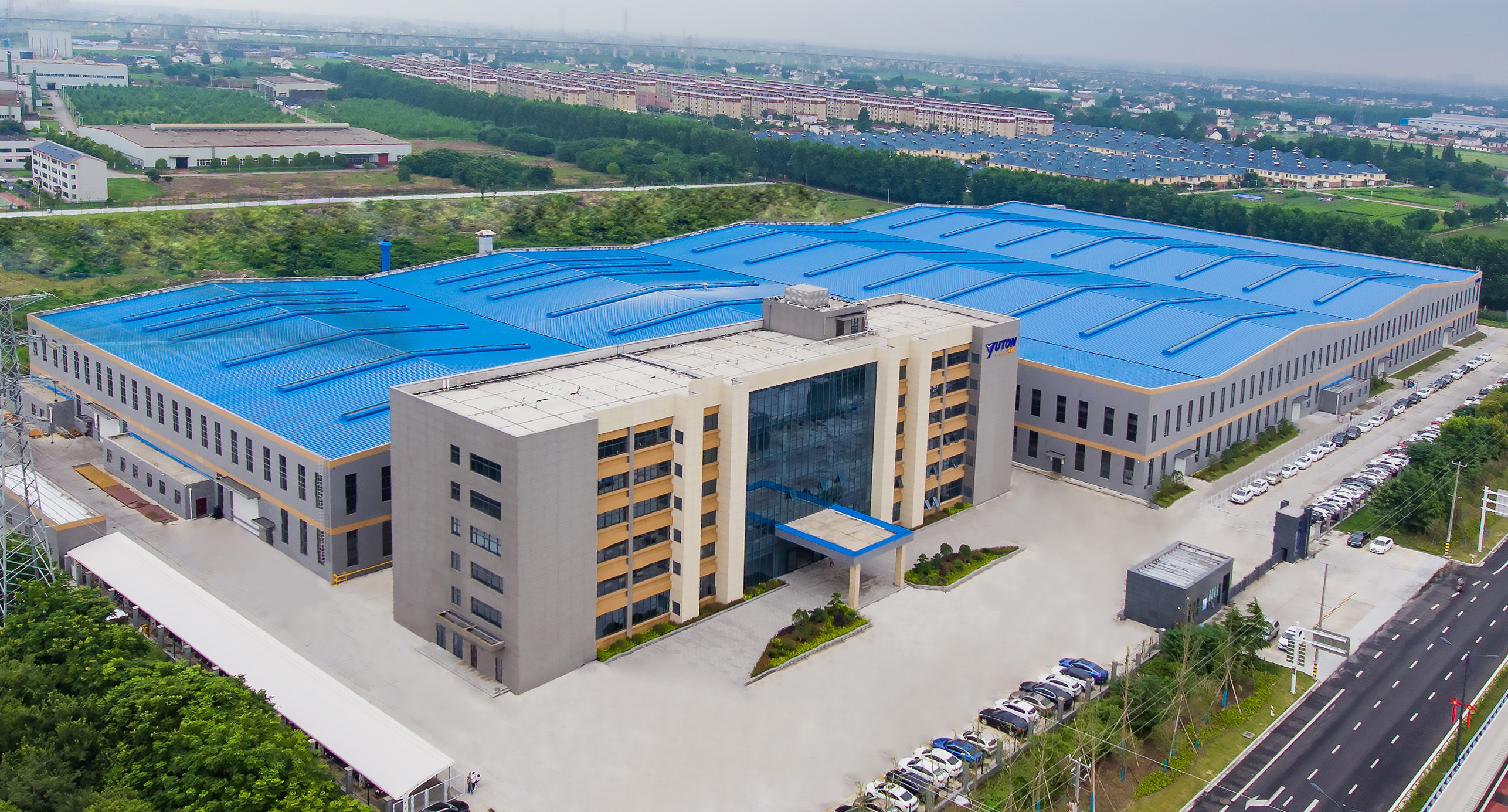
For company context, visit NANTONG YUETONG CNC EQUIPMENT CO.,LTD. The official site and the brochure are supplied references; they do not replace the written quotation or the sample trial.
Have Questions or Need More Details?
Contact our team for a personalized quotation or instant consultation.
Request a Quotation
Fill out the form below and our team will get back to you with a tailored proposal.
WhatsApp Direct Chat
Prefer to chat in real-time? Message us on WhatsApp for instant assistance & quick answers.
- Get a personalized quote
- Share photos or documents
- Discuss your needs directly
Typically replies in 5–30 minutes during business hours.