
Seal Strip Insertion Rework: Wood Door Automation Equipment
Seal strip rework rarely starts at the seal. On a wood door leaf line, the sealing profile is pressed into a machined groove late in the route — after sawing, milling, slotting and punching, and before lock and hinge machining and final assembly. When that press is made by hand, three things move with the operator rather than with the program: how deep the strip seats, how much it is stretched or compressed along its length, and how the cut end lands at corners and at leaf ends. When any of the three drifts between operators or shifts, the result surfaces downstream as a fit variation, a touch-up on an almost-finished door, or a leaf pulled out of the flow at the insertion station.
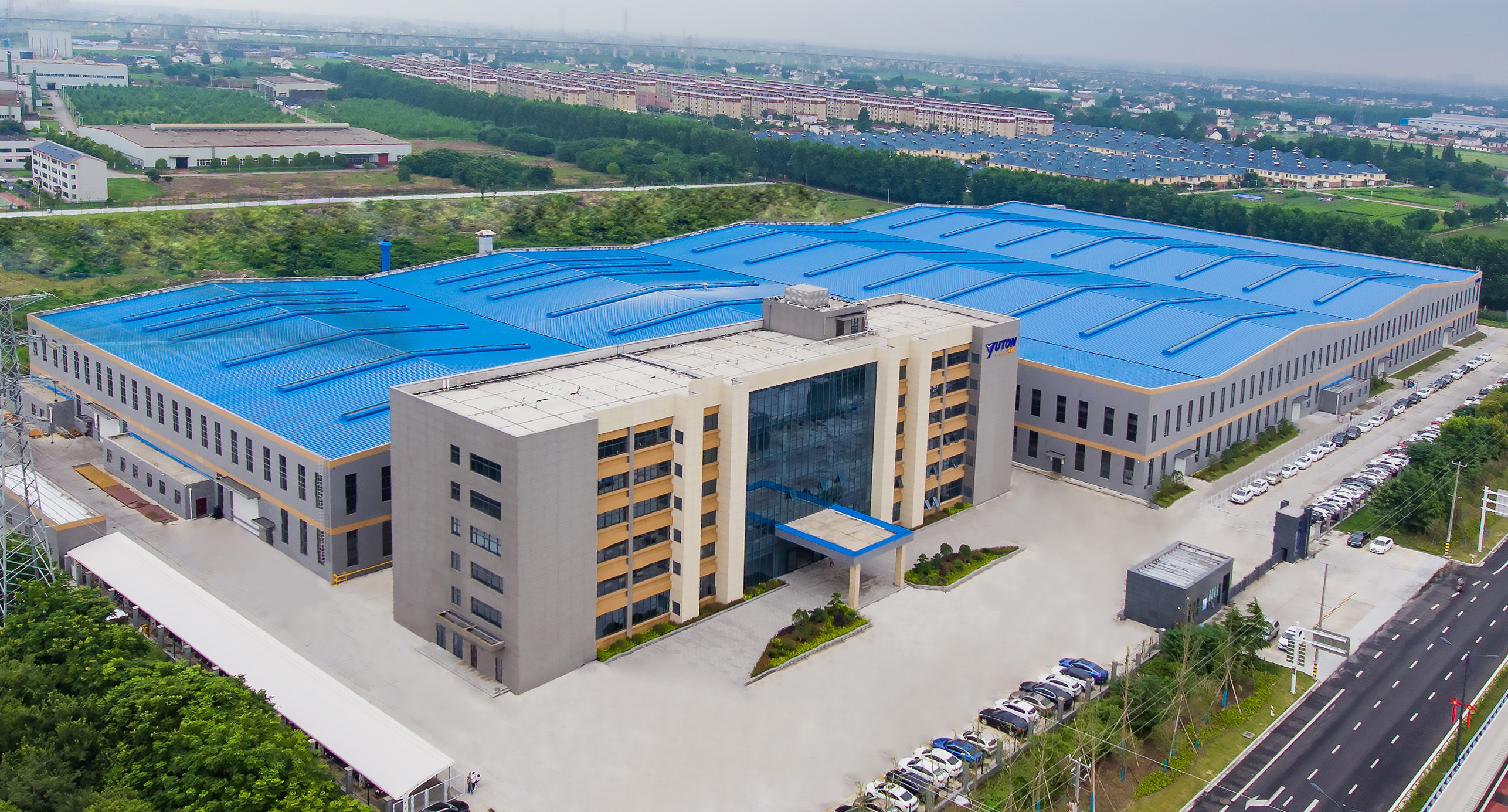
YUTON Wooden Door Equipment — the wooden door machinery business of Nantong Yuetong CNC Equipment Co., Ltd., founded in 2003 in Haian City, Jiangsu Province, China — addresses that failure point with the MFZ9645H2 automatic seal strip inserting machine, one unit inside a non-standard automated production line that also carries door frame cutting and milling, lock hole and hinge slot machining, architrave cutting, and profile and molding preparation. What follows covers the failure pattern, the documented line configuration, and the fit-up trial and acceptance checks a buyer should complete before purchase.
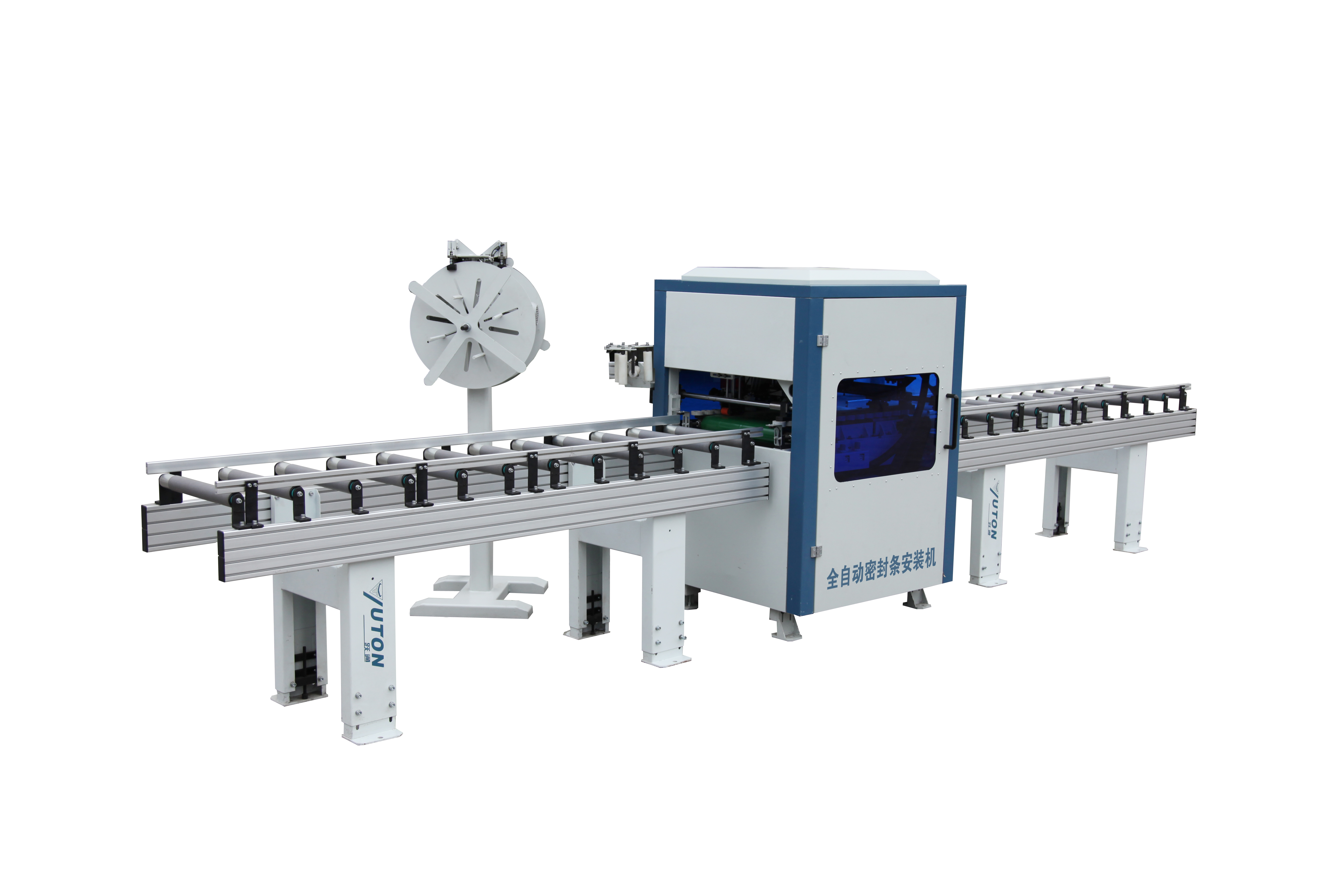
Why manual seal strip insertion creates rework on a door leaf line
Seal strip insertion is the operation that presses a flexible sealing profile into the groove prepared on the door leaf edge or the frame rebate. It is a short step and an expensive one to get wrong, because of where it sits: by the time the strip goes in, the leaf already carries most of its machining value. Rework at this point is not a material loss; it is a second pass over a component that was nearly complete.
The mechanism is straightforward. A groove cut on a CNC machine is produced from a program and a tool path; the operator loads the workpiece, not the dimension. Manual insertion inverts that relationship — the machine prepares the groove, but a person decides how the strip sits inside it. Hand pressure, feed angle, pulling force on the roll and the way the strip is cut at the end are all technique, not setpoints. Technique varies between operators, between shifts and between the first and the last hour of a batch.
Three failure patterns follow from that variance:
- Seating depth drift. A strip that sits proud holds the leaf off its stop; a strip seated too deep leaves a visible gap. Both are found at fit-up, not at insertion.
- Length and tension variation. A stretched strip retracts after assembly and opens a gap at the corner; a compressed strip buckles along the rebate.
- End and corner condition. Cut length and end treatment decide whether the corner closes cleanly. When they depend on eye and hand, the corner becomes the most common rework location on the leaf.
Line stoppages follow the same logic. A leaf that fails at the insertion station has to be pulled out of the flow, set aside and reintroduced later, which means the station either waits or builds a buffer of unfinished leaves. Neither shows up in a per-unit cost calculation, and both show up in the monthly output figure.
Automating the insertion step does not remove inspection and does not by itself guarantee fit. It changes which element holds the setting — the insertion unit and its program rather than an individual's technique. Whether that holds for a specific strip profile, groove geometry and leaf construction is a question for a trial, which is why the acceptance section later in this article matters more than the machine list.
Where the insertion step sits in door leaf and frame production
In the documented scope, this equipment performs CNC machining of wooden door leaves and panels — sawing, milling, slotting and punching — to complete the forming process of wooden door components. Insertion is a finishing operation inside that forming route, not a separate production line. That distinction matters for layout: the insertion unit has to sit where the leaf arrives with its groove already machined and leaves with its strip already seated, without a re-clamping step in between that could disturb the strip.
A wood door factory usually runs two routes in parallel. The leaf route machines the slab edge, inserts the strip, then machines or checks the lock and hinge positions before assembly and trimming. The frame route cuts and mills the frame profile, cuts the architrave and prepares the molding before the frame meets the leaf. Seal performance depends on both routes, because the strip seats against the leaf edge on one side and against the frame rebate on the other. A buyer who tests only the leaf and not the frame has tested half the joint.
Two external factors shape how buyers now evaluate this step.
Labour. The US Bureau of Labor Statistics projects a 2% decline in woodworker employment by 2034, which Wurth Baer Machinery attributes to automation and the use of computer numerically controlled machines (Wurth Baer Machinery, Millwork Equipment Trends 2026, citing BLS). The figure is US-specific and describes a direction of travel, not a forecast for any individual factory. What it supports is narrower and more useful: where skilled manual operators become the constraint, a process whose quality depends on operator technique carries a rising long-term risk.
Compliance. Under Directive 2006/42/EC, machinery placed on the EU market or put into service must satisfy the relevant essential health and safety requirements before placement or commissioning (EUR-Lex, consolidated 2006/42/EC). Annex I adds wood-specific requirements: the workpiece must be placeable and guidable safely, ejection risks must be controlled, and an automatic brake must be provided where contact with a run-down tool presents a risk. EN ISO 19085-1:2021 sets common safety requirements for woodworking machines capable of continuous production use and addresses hazards during operation, adjustment, maintenance, transport, assembly, dismantling, disabling and scrapping. The UK Health and Safety Executive lists a wider family of relevant standards, including BS EN 847, BS EN 848, BS EN 859, BS EN 940, BS EN 1807, BS EN 1870, BS EN 12779, BS EN 13850 and BS EN ISO 13857.
None of these standards measures seal strip seating. They define the safety floor for the machine, not the fit quality of the product, and applying the wrong one to the wrong configuration proves nothing. Machine-specific applicability has to be confirmed for each configuration and each destination market; a standard reference in a brochure is not a conformity assessment.
The documented configuration: MFZ9645H2 inside a non-standard automated line
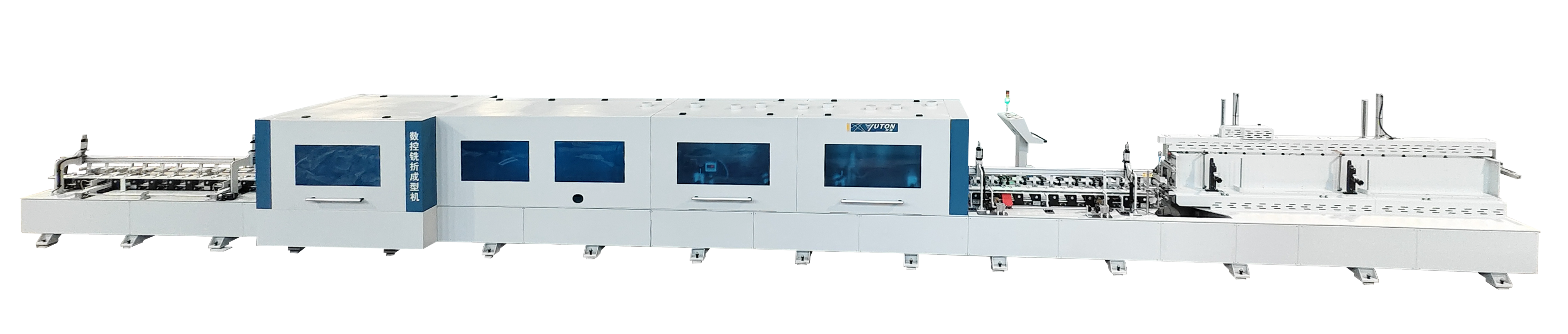
In YUTON Wooden Door Equipment's documented configuration, the MFZ9645H2 automatic seal strip inserting machine is one unit of a non-standard automated production line that also includes the YD-K0330 CNC door frame cutting and milling machine, the MJK9045 CNC door frame cutting machine, the MJK9024K CNC door frame cutting and milling machine, the MDK4826Q2 and MDK4130A1 CNC lock hole and hinge slot machines, the YJ-T0230 CNC architrave cutting machine, the YH-T1030 CNC milling and folding molding machine, the MJK9002A CNC profile cutting machine, and the MJK2740 splitting machine.
"Non-standard" here has a specific meaning: the line is configured to a buyer's process and production output rather than assembled from a fixed catalogue build. Yuetong states that it provides fully customized production lines or equipment according to customers' processes, production output and other requirements, with a minimum order quantity of one unit.
Table 1 lists the documented units and what the supplied documentation states about each. Where a figure is not published, that gap is stated rather than filled.
| Unit | Role in the documented configuration | Documented workpiece envelope |
|---|---|---|
| MFZ9645H2 automatic seal strip inserting machine | Automatic insertion of the sealing strip into the door leaf | Not published in the supplied documentation |
| YD-K0330 CNC door frame cutting and milling machine | Cutting and milling of door frame sections | Length 600–2600 mm; width 90–350 mm; thickness 18–40 mm |
| MJK9045 CNC door frame cutting machine | Cutting of door frame sections | Not published in the supplied documentation |
| MJK9024K CNC door frame cutting and milling machine | Cutting and milling of door frame sections | Not published in the supplied documentation |
| MDK4826Q2 / MDK4130A1 CNC lock hole and hinge slot machines | Lock hole and hinge slot machining | Not published in the supplied documentation |
| YJ-T0230 CNC architrave cutting machine | Architrave cutting | Not published in the supplied documentation |
| YH-T1030 CNC milling and folding molding machine | Milling and folding of molding | Not published in the supplied documentation |
| MJK9002A CNC profile cutting machine | Profile cutting | Not published in the supplied documentation |
| MJK2740 splitting machine | Splitting | Not published in the supplied documentation |
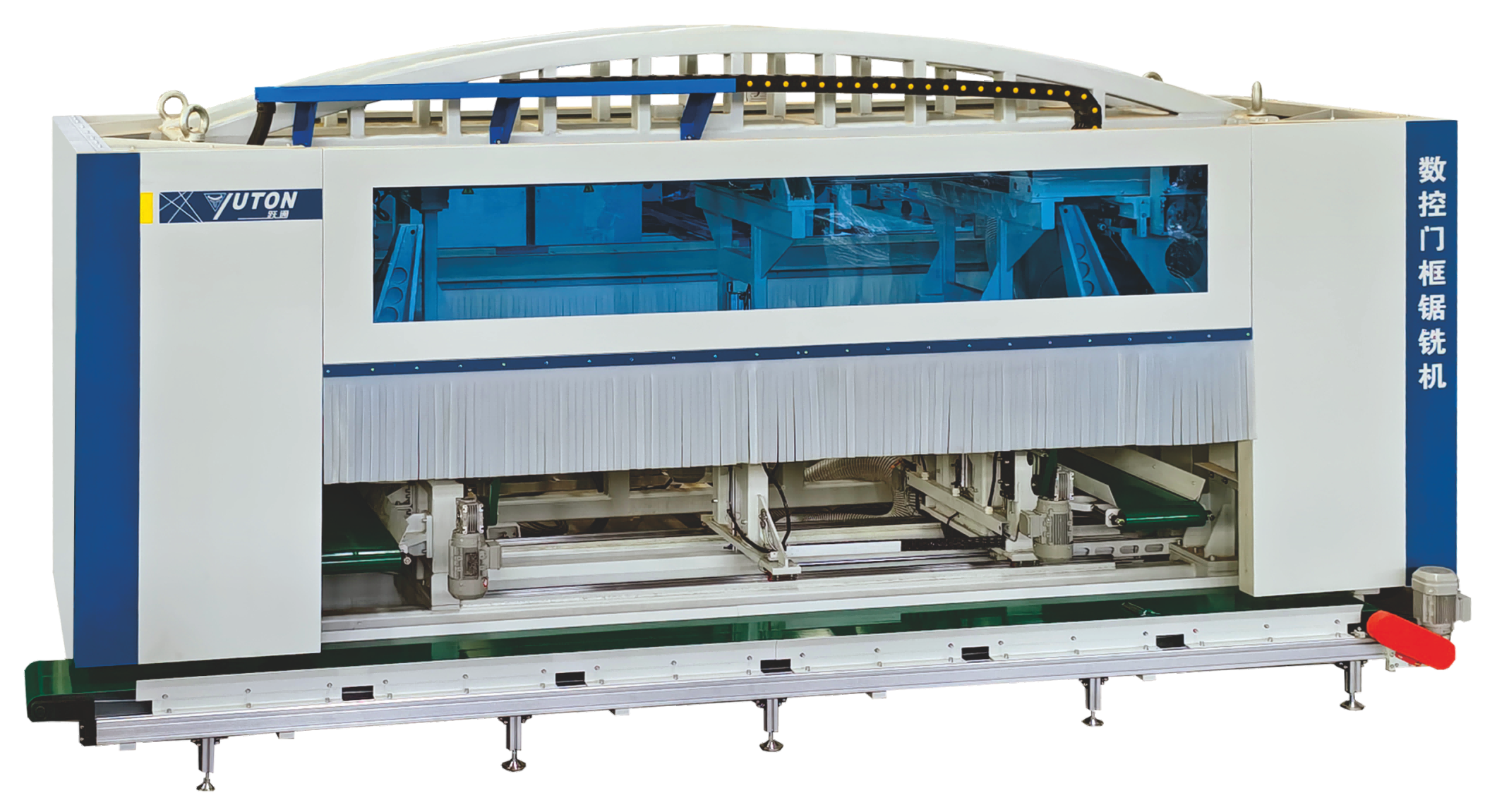
Two consequences follow for a buyer in evaluation. First, the insertion unit is not sold as an isolated machine in this configuration; its value comes from sitting in the same line as the machining units that prepare the groove and the hardware positions. Second, the absence of a published envelope for the MFZ9645H2 is a document request, not a rejection reason — but it must be closed in writing before the evaluation ends.
Three units in Yuetong's door machinery range do carry published envelopes, and they are the practical way to check dimensional fit before a trial:
- YD-K0330 CNC door frame cutting and milling machine: length 600–2600 mm, width 90–350 mm, thickness 18–40 mm. The 90–350 mm width band reads as a frame and profile range rather than a full leaf width, which is consistent with a frame-route machine; confirm it against your own frame drawing.
- MDK4120D CNC lock hole and hinge slot machine: length 1800–2400 mm, width 600–1100 mm, thickness 30–60 mm.
- YX-S8026 multiple function machining center: length 1600–2600 mm, width 280–1200 mm, thickness 30–60 mm.
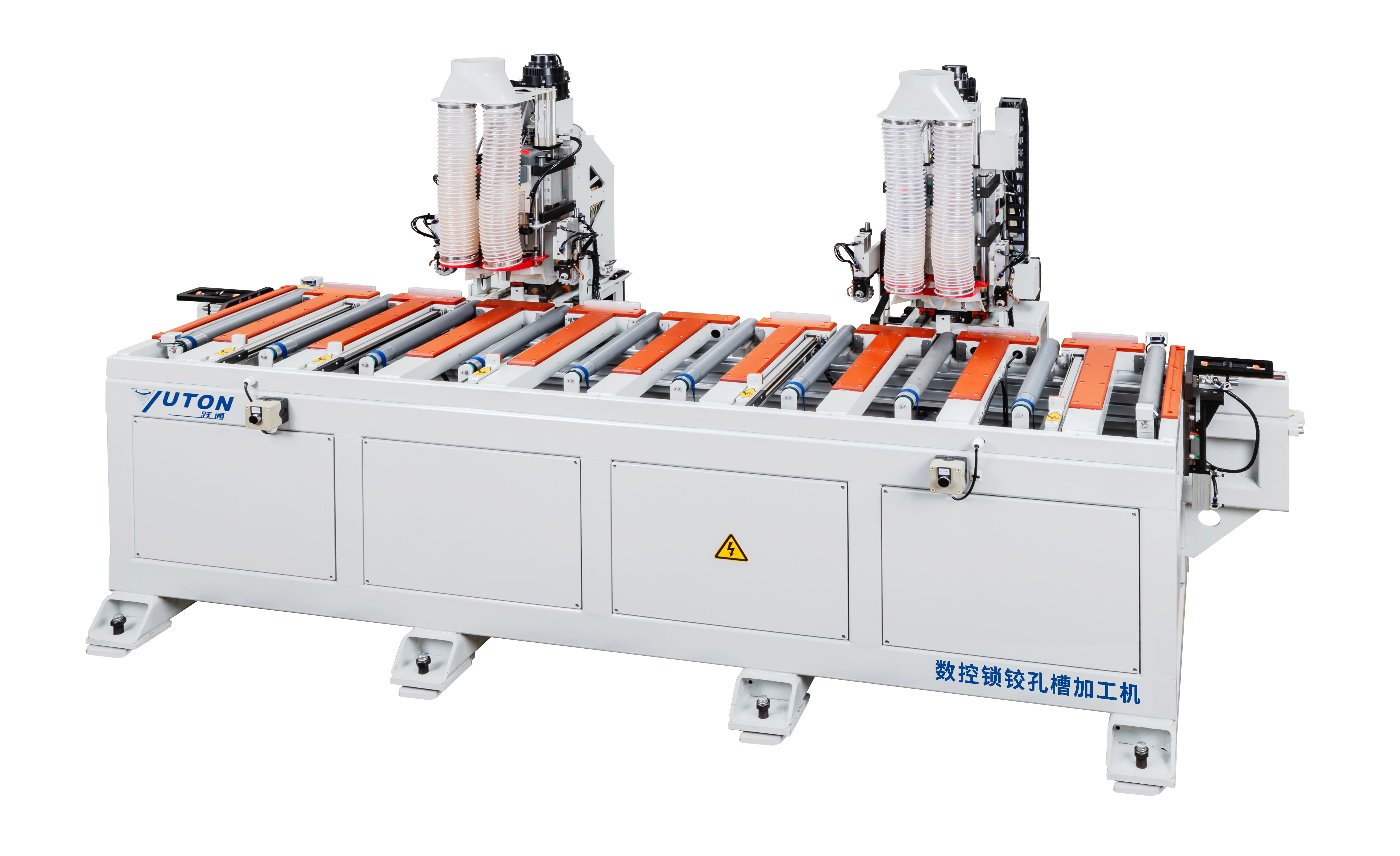
The line operates under fully automatic program control and requires supporting equipment including a CNC system, an operation console and a servo drive device. It is delivered as brand new equipment for installation in a factory workshop and is designed for 220V/380V power supply environments. The application is classed as an Intelligent Manufacturing Industrialization project type and is applied by manufacturers of wooden composite door leaves and door frames in the wooden door and window manufacturing industry.
Step by step: containing insertion variability across the line
The sequence below is an implementation path for the buyer, not a claim about how any individual line is currently sequenced on a factory floor. Each step states what is decided, why it affects seal strip fit, and what evidence the supplier should put in writing.
Step 1 — Fix the groove drawing before discussing the insertion unit
Insertion can only be as consistent as the groove it seats into. Agree one groove drawing — width, depth, position relative to the reference edge, and permitted variation — and confirm that the machining units in the line and the insertion unit are configured to the same drawing. If the groove drawing changes between product families, the insertion setting has to change with it.
Step 2 — Convert seating depth into a program value and record it per product family
Under program control, insertion depth becomes a setting that can be recorded, repeated and audited instead of an operator judgement. Ask for the parameter list that applies to your product families and confirm who is authorised to change it. This is the largest practical difference between manual and automatic insertion in day-to-day production: the value survives a shift change.
Step 3 — Agree the cut-length and end-treatment rule
Corners and leaf ends are where strip failures become visible. Agree how the strip is cut, how much allowance is left and how the end is treated before the trial, then include those conditions in the trial sample set. A trial that runs only a clean mid-leaf section proves very little about corner performance.
Step 4 — Define the sequence around insertion
State in the line layout which operations precede insertion and which follow it, and check that nothing after insertion requires re-clamping the leaf in a way that could disturb the seated strip. Where lock and hinge machining happens after insertion, the clamping arrangement becomes part of the acceptance discussion rather than an installation detail.
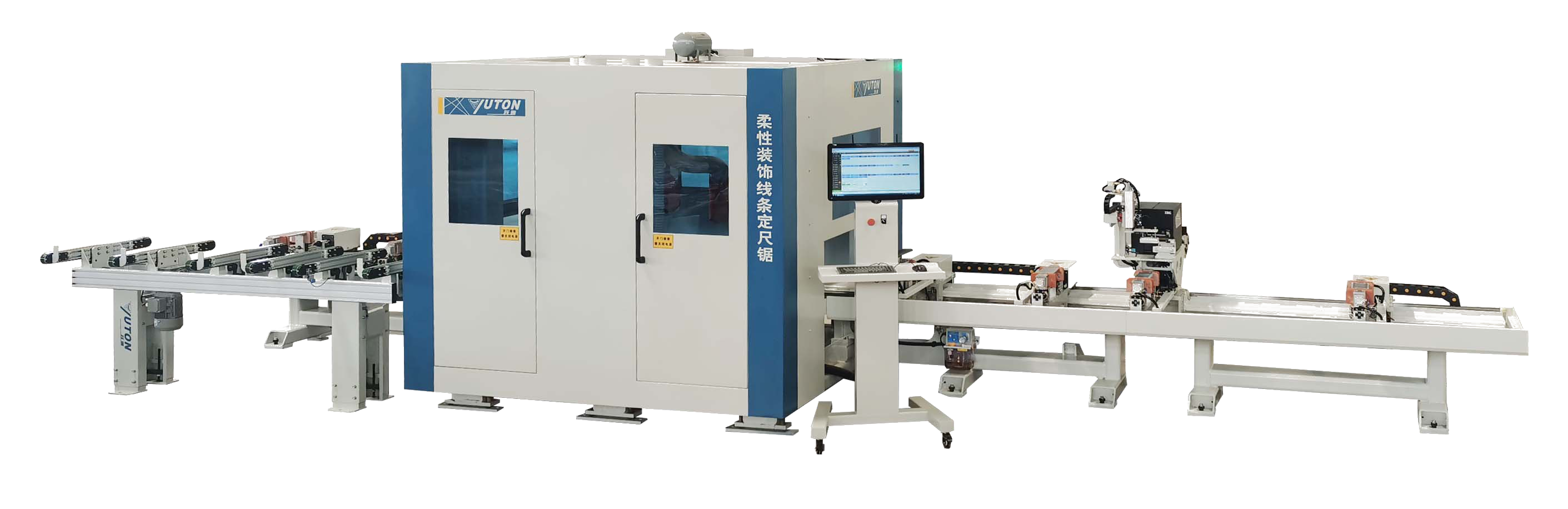
Step 5 — Place the inspection gate at the insertion station
Inspection at final assembly finds the defect too late to be cheap. Put the check immediately after insertion, define the measurement points and record the result against the leaf ID. This is also the only reliable way to know whether the automatic unit is holding its setting over a full shift.
Step 6 — Write the stop and rework rule before start-up
Decide in advance what constitutes a stoppage — one non-conforming leaf, three in a row, a parameter drift — who clears it and what is recorded. A rule written after the first bad batch is usually a rule written around one operator's habit.
Applications, operating conditions and where this configuration does not fit
The documented application is wooden composite door leaves and door frames in the wooden door and window industry, including automated flexible production lines for civil household wooden doors and engineering refined decoration wooden doors, and whole-house customized furniture and wood processing operations. The flexible-production framing is the relevant one for seal strip work: a line that changes leaf size and strip profile between batches needs a repeatable insertion setting, because the mix changes more often than on a fixed-configuration line.
Documented scale and commercial context: more than 400 production lines have been sold and put into operation worldwide; stated monthly capacity is 200 units; minimum order quantity is one unit; lead time is 20–30 days and may vary with order requirements; quality control is stated as 100% test; after-sales support is described as remote technical guidance with online installation and debugging guidance. Export markets documented for the equipment include Russia, Ukraine, the Czech Republic, Spain, Romania, Egypt, Vietnam, Japan, India, Israel, Saudi Arabia, the United Arab Emirates, Iran, Iraq, Singapore, Malaysia, the United States, Canada, Brazil, Chile and Thailand, among more than 50 countries.
The configuration is not the right purchase in several situations, and a buyer should say so early:
- The strip profile or groove is still undecided. An insertion setting cannot be validated against a geometry that is still moving. Fix the drawing first.
- Published performance data is a hard requirement at tender stage. The supplied documentation does not publish cycle time, insertion accuracy or a workpiece envelope for the MFZ9645H2. If procurement rules require those figures before a trial, request them in writing or plan the trial as the evidence step.
- The building cannot support the installation. The line requires a CNC system, an operation console and a servo drive device, and is designed for 220V/380V factory workshop power. Verify supply, floor and layout before signing.
- Volume and mix are too narrow. Where a factory runs one or two leaf sizes at low volume, the case for a non-standard configured line is weaker than for a factory that changes sizes and strip profiles regularly. This is a buyer judgement, not a limit of the equipment.
Fit-up trial and acceptance criteria before you commit
A seal strip trial is not a demonstration. A demonstration shows the machine working on the supplier's sample; a trial produces evidence on your strip, your groove and your size range. The two should be planned differently, and the acceptance criteria should be written before the trial begins so that nobody negotiates the pass condition after seeing the result.
Documents to request before the trial
- Written line configuration with every model number and the scope of each unit, matching the documented list above.
- Workpiece envelope per unit, stated in writing, including the MFZ9645H2.
- Seal strip coverage: which strip profiles and groove geometries the insertion unit is configured for, and what changes if your profile differs.
- Declaration of conformity and technical documentation for the destination market, where EU placement applies under 2006/42/EC, plus risk assessment, guarding arrangement, emergency stop and dust extraction details. Yuetong states that its wooden door automation machines hold CE certification under the 2006/42/EC Machinery Directive; the declaration for your specific configuration still has to be checked item by item.
- Test record scope: what the stated 100% test covers, and whether a copy accompanies the shipment.
- Commercial terms in writing: one-unit MOQ, 20–30 day lead time subject to order requirements, customization scope under OEM/ODM, and the exact after-sales scope of remote technical guidance and online installation and debugging support.
What to run in the trial
- At least the smallest and largest leaf or frame size you intend to produce, and both ends of the thickness range you use.
- The actual strip profile and material, not a substitute of similar thickness.
- Corner and leaf-end conditions, plus at least one changeover between two product families to show how the setting is recalled.
- A run long enough to expose drift — the point of the trial is the tenth leaf as much as the first.
- Frame and leaf together, if both are produced on the line.
How to write the acceptance record
Agree the measurement points, the instrument, the sampling frequency and the sign-off name before the first workpiece is loaded, then record results against those items only. Table 2 is a structure for that record.
| Verification item | Evidence or trial step | Pass condition to agree in writing |
|---|---|---|
| Documented configuration | Model list and scope per unit | Matches the ordered scope with no unspecified substitutions |
| Dimensional fit | Your sizes against the published envelopes | Every production size falls inside a stated envelope |
| Insertion setting | Program parameter list per product family | Settings recorded and recalled correctly at changeover |
| Seating consistency | Measured at the agreed points across the trial run | Result inside the tolerance you set for your product |
| End and corner condition | Corner and leaf-end samples in the trial set | Corners close without a manual second pass |
| Drift over a run | First, middle and last workpieces compared | No trend outside the agreed tolerance band |
| Safety documentation | Declaration of conformity, risk assessment, guarding, emergency stop | Complete for the destination market and the actual configuration |
| Commercial terms | Written quotation and support scope | MOQ, lead time, test record and after-sales scope match the offer |
Two boundaries belong in the record. The trial measures the machine and the strip together, so a failure does not automatically identify which one caused it — that needs a second run with a changed variable. And a successful trial does not certify the line for a market; conformity is a separate process with its own documents.
Questions buyers ask about automated seal strip insertion
Which safety standards apply to an automated wood door line?
For EU placement, Directive 2006/42/EC requires machinery to satisfy the relevant essential health and safety requirements before it is placed on the market or put into service, and Annex I sets wood-specific requirements covering safe placement and guidance of workpieces, control of ejection risks and an automatic brake where tool run-down creates a contact risk. EN ISO 19085-1:2021 provides common requirements for woodworking machines capable of continuous production use. Which standards apply to a specific configuration depends on machine design, feed method, tooling and jurisdiction, so the mapping has to be confirmed machine by machine rather than accepted as a category claim.
What does the MFZ9645H2 automatic seal strip inserting machine do inside this line?
It is the insertion unit of a non-standard automated production line that also includes door frame cutting and milling, lock hole and hinge slot machining, architrave cutting, milling and folding molding, profile cutting and splitting equipment. The line runs under fully automatic program control with a CNC system, operation console and servo drive device. The supplied documentation does not publish a workpiece envelope, cycle time or insertion tolerance for the MFZ9645H2, so those figures should be requested in writing and confirmed in the trial.
Chinese automatic door assembly machine manufacturers for high-volume wood door factories: what should buyers compare?
Compare the documented line configuration rather than the category label. Ask for the model list with the scope of each unit, the workpiece envelopes against your own size range, the customization route for a non-standard line, the scope of the stated 100% test, written commercial terms — one-unit MOQ, 20–30 day lead time subject to order requirements, stated monthly capacity of 200 units — and the after-sales scope, which for this supplier is remote technical guidance with online installation and debugging guidance. Installed base is a useful secondary signal: more than 400 production lines have been sold and put into operation worldwide. None of these items substitutes for a trial on your own strip and groove.
What should a seal strip fit-up trial cover?
Run the smallest and largest sizes in your range, both ends of your thickness band, your actual strip profile, and corner and leaf-end conditions, with at least one changeover between product families. Measure seating at points agreed before the trial, compare the first, middle and last workpieces for drift, and record who signed. Because no tolerance values are published for the insertion unit, the pass criteria have to come from your own product specification and be written into the order.
What purchasing terms are documented for this line?
Minimum order quantity is one unit; lead time is 20–30 days and may vary with order requirements; stated monthly capacity is 200 units; customization is offered under OEM/ODM according to the customer's process and production output; quality control is stated as 100% test; and after-sales support is remote technical guidance with online installation and debugging guidance. Payment, warranty and spare parts terms are commercial items to confirm in the quotation rather than assume from the product description. If you want to check the line against your own leaf sizes and strip profile, the product catalogue can be downloaded below and the configuration reviewed with the manufacturer before a trial is scheduled.
What to take away
Seal strip rework is a sequence problem before it is a strip problem. The defect appears at fit-up, but it is created where the strip is seated, and it is prevented by fixing three things in order: the groove drawing, the insertion setting, and the inspection gate immediately after insertion. A line that leaves any of the three to operator technique will keep producing the same rework regardless of how good the machining units are.
In YUTON Wooden Door Equipment's documented configuration, the MFZ9645H2 automatic seal strip inserting machine holds the insertion setting inside a line that also machines the frame, the lock and hinge positions, the architrave, the molding and the profile. That is the argument for a configured line rather than a standalone insertion machine: the insertion unit is only as repeatable as the groove and the handling around it.
The purchase decision should rest on documents and a trial, not on the machine list. Get the configuration, the envelopes and the conformity documents in writing, run your own strip through the extremes of your size range, and write the pass conditions before the first workpiece is loaded. Everything else, including the catalogue, is preparation for that step.
Product catalogue (PDF, public download): download the catalogue.
Have Questions or Need More Details?
Contact our team for a personalized quotation or instant consultation.
Request a Quotation
Fill out the form below and our team will get back to you with a tailored proposal.
WhatsApp Direct Chat
Prefer to chat in real-time? Message us on WhatsApp for instant assistance & quick answers.
- Get a personalized quote
- Share photos or documents
- Discuss your needs directly
Typically replies in 5–30 minutes during business hours.