
Automatic Door Assembly Machine: Wood Door Automation Equipment Guide
Buyers searching for an automatic door assembly machine usually expect to find a single model number. In the wooden door industry, that expectation is the first thing that has to be corrected. An automatic door assembly machine is not one product — it is a configured set of program-controlled machines that bring door leaves, door frames and architrave profiles to final shape before they reach assembly, edge-banding or coating.
This guide covers what the equipment family contains, which manual operations it replaces, what safety requirements apply before a machine can be placed on the market, and how a first-time buyer should approach the decision.
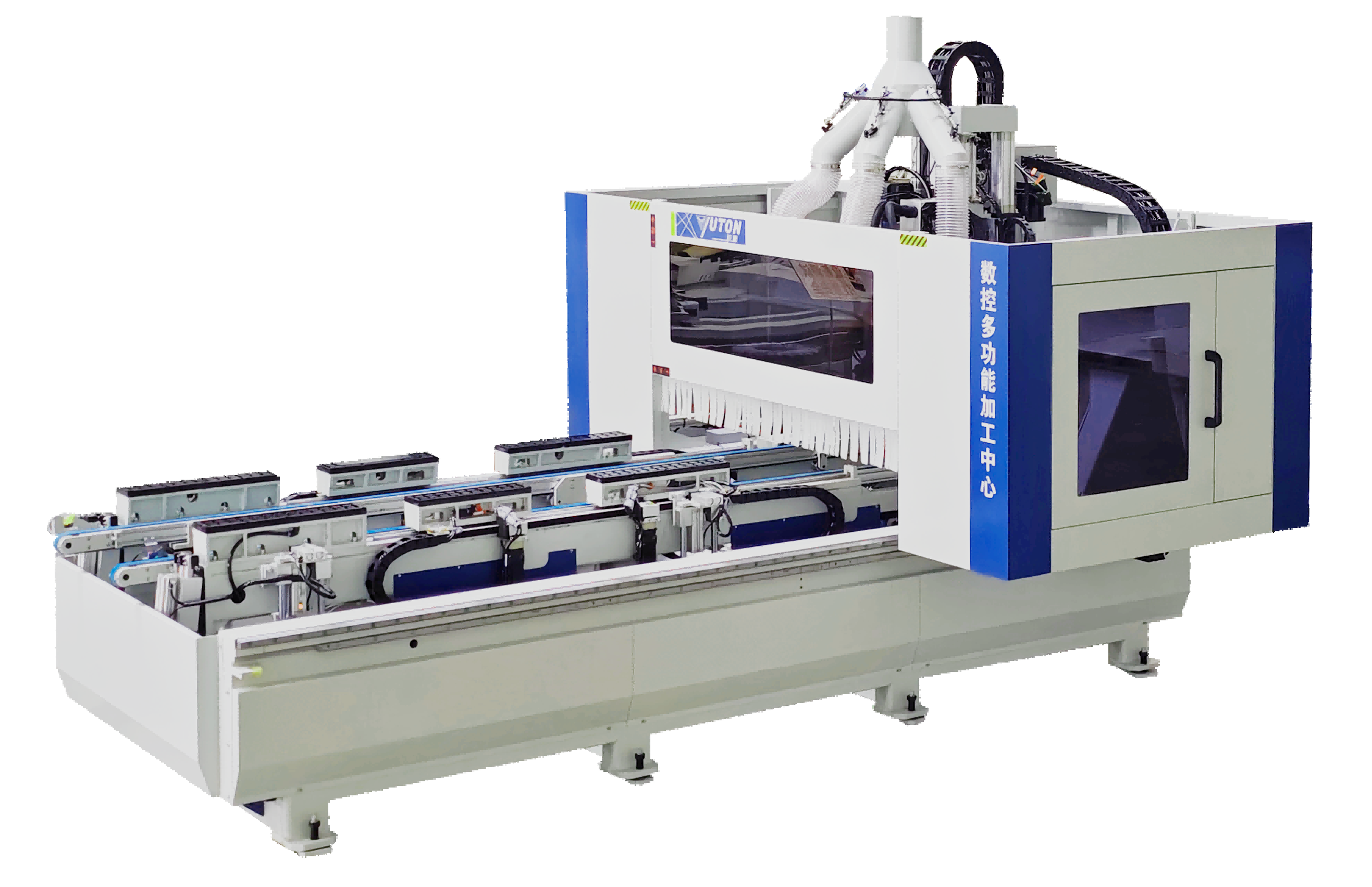
What Is an Automatic Door Assembly Machine?
An automatic door assembly machine is a computer numerically controlled (CNC) machining unit that performs sawing, milling, slotting and punching on wooden door leaves, door frames and panels in order to complete the forming process of wooden door components. It does not carry out the final joined assembly of the door itself — that belongs to downstream assembly operations — but it is responsible for making every dimension, rabbet and slot accurate before the leaf or frame enters that stage.
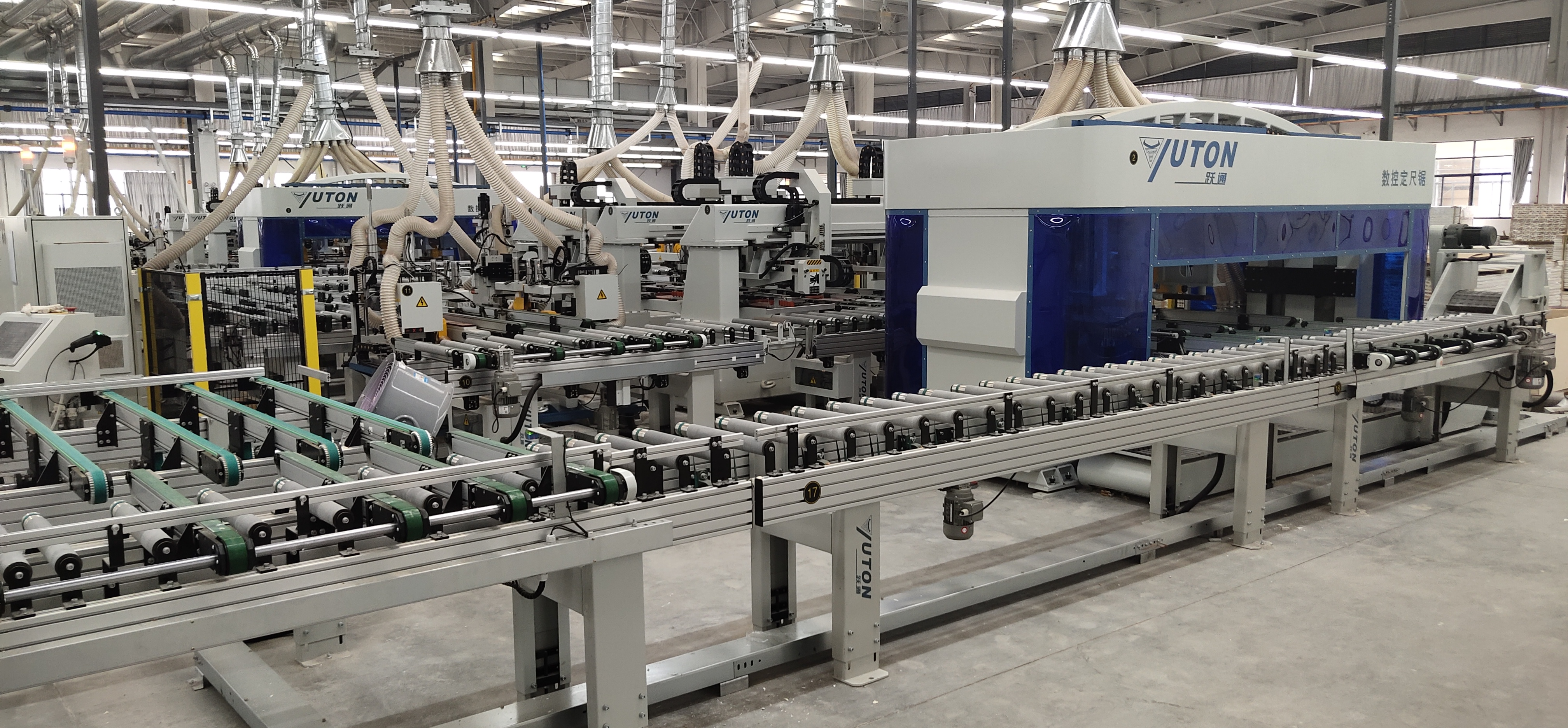
According to product documentation from NANTONG YUETONG CNC EQUIPMENT CO.,LTD, which manufactures under the YUTON brand, the equipment is delivered as a non-standard automated production line and is classified into three equipment families: door leaf processing equipment, door frame processing equipment and profile processing equipment. The line operates in fully automatic program-control mode and is equipped with components including a CNC system, an operation console and servo drive devices.
- Operation mode: fully automatic program control
- Working condition: brand new, 220V / 380V, installed in factory workshops
- Equipment families: door leaf processing, door frame processing, profile processing
- Primary structural material: iron
Why Wood Door Automation Equipment Is Drawing More Buyer Attention
Machinery spending is rising while the woodworking labour pool is shrinking. Neither of those statements is a marketing claim — both come from citable sources.
The global woodworking machinery market was valued at USD 5.27 billion in 2025 and is projected to reach USD 8.53 billion by 2035, a 5.1% CAGR, according to Fortune Business Insights' Woodworking Machinery Market Size, Share & Trends Analysis 2026 to 2035 (published August 2026). That scope includes CNC, automatic and manual woodworking equipment, including specialised door machinery.
On the demand side, the US Bureau of Labor Statistics projects that woodworker employment will decline 2% to 211,100 by 2034, citing automation and the use of computer numerically controlled machines as a cause (reported by Wurth Baer Machinery, 2026).
Read together, the two figures describe the same procurement logic: capital budgets for wood processing equipment are expanding while skilled manual capacity becomes harder to secure. For a door factory, automation stops being a question of scale and becomes a question of labour continuity.
YUTON has operated in this category since it was founded in 2003, giving the company over 20 years of experience in the wooden door automation equipment industry. Its manufacturing facility covers 110,666.67 square meters, employs approximately 155 staff and supports an annual production capacity of 2,400 units. Its R&D team consists of 55 engineers and technicians, and its export ratio is approximately 70%, with equipment delivered to more than 50 countries.
The Three Equipment Families Inside a Wood Door Automation Line
Every configuration on a wooden door production line falls into one of three processing families. Knowing which family a machine belongs to is the fastest way to understand what it does.
Door Leaf Processing Equipment
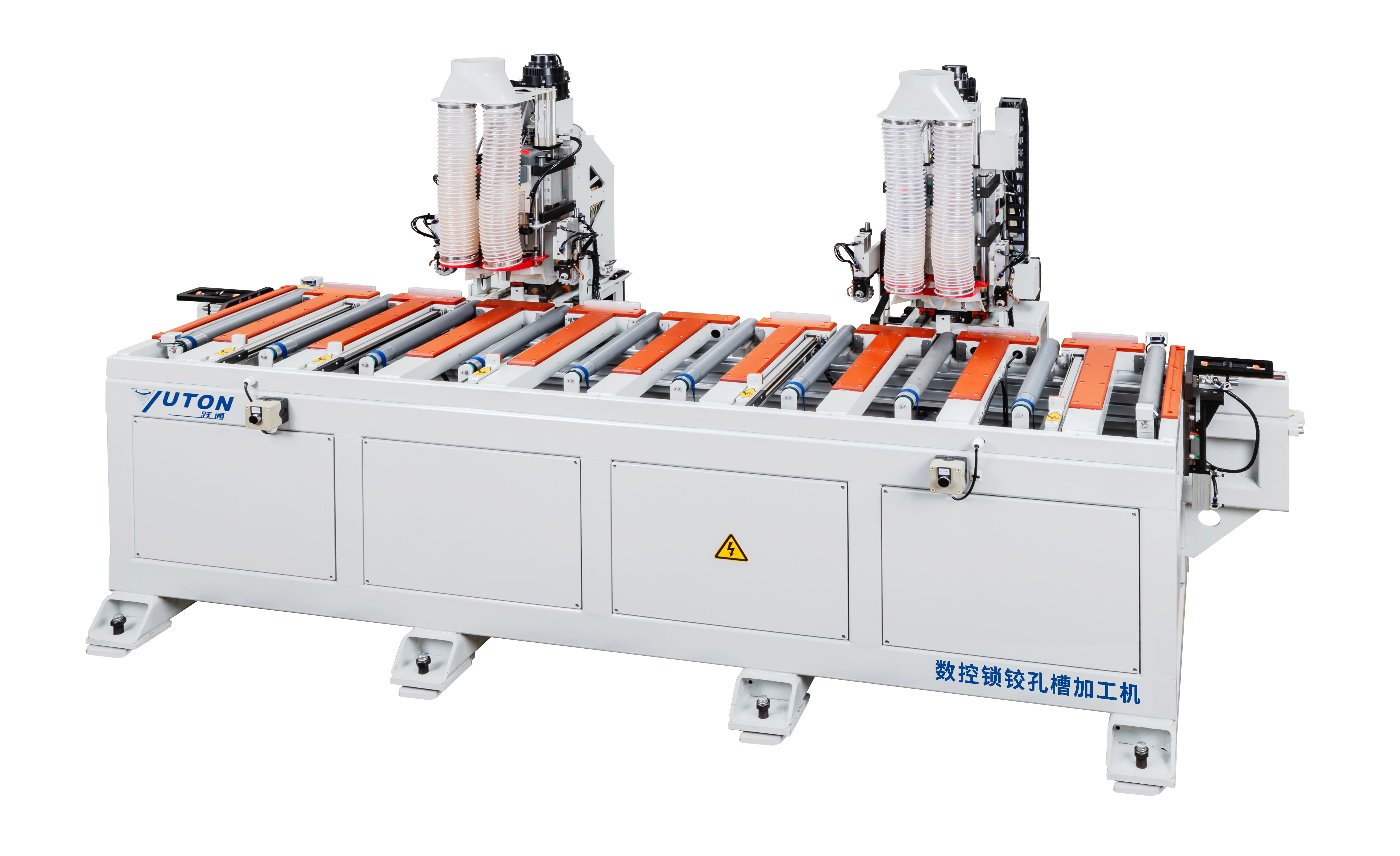
Door leaf processing equipment handles the forming operations on the leaf itself — fixed-length sawing, squaring, lock and hinge mortising, and seal strip insertion. Within the YUTON product line this family includes:
- MDK4826Q2 CNC lock hole & hinge slot machine — lock holes and hinge slots
- MDK4130A1 CNC lock hole & hinge slot machine — same function, different working envelope
- MDK4120D CNC lock hole & hinge slot machine
- MFZ9645H2 automatic seal strip inserting machine
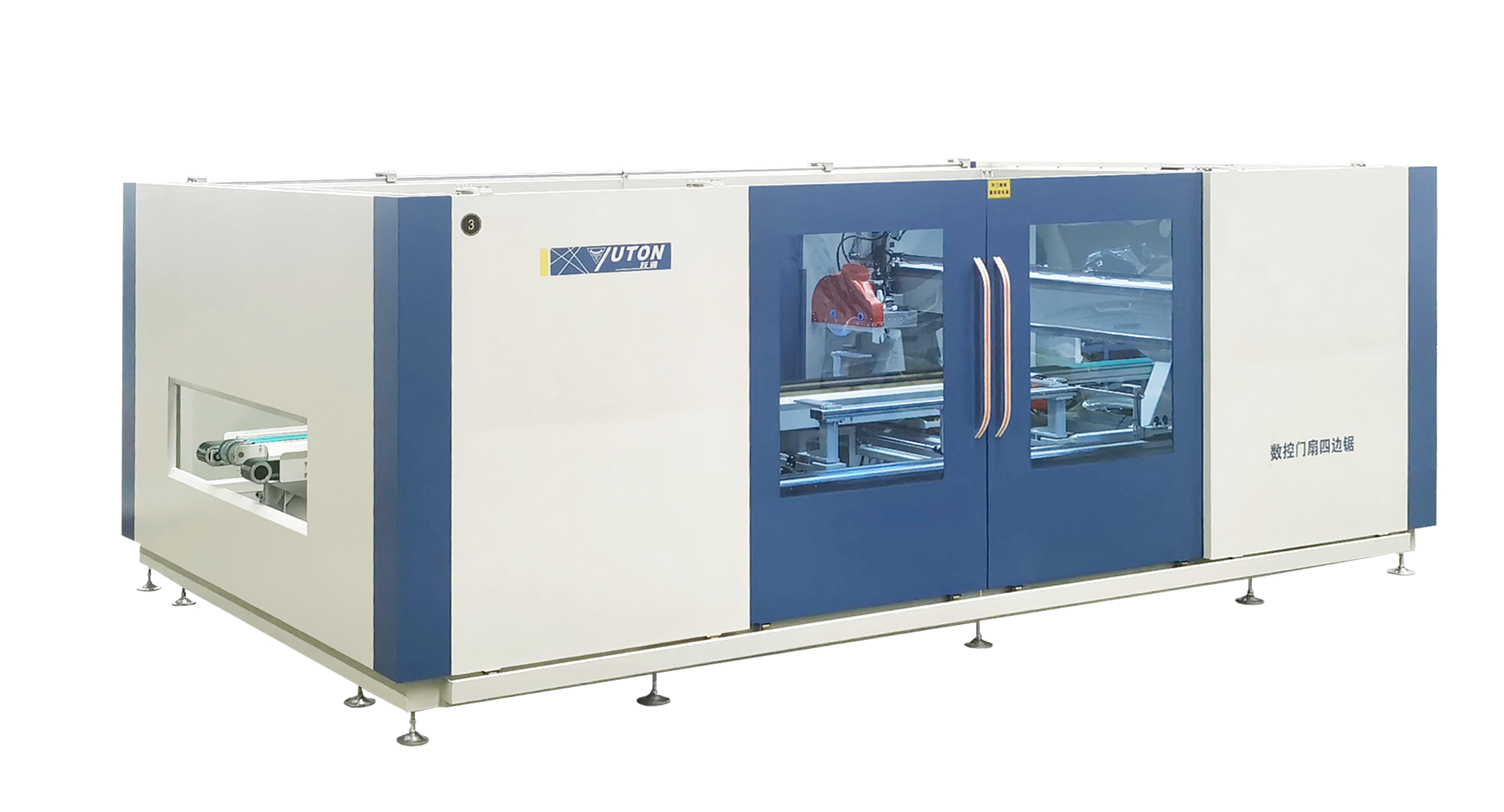
- YJ-S0320D CNC door four edges saw
This is usually the first family a factory automates, because lock and hinge mortising are the most repetitive manual stations on a door leaf line.
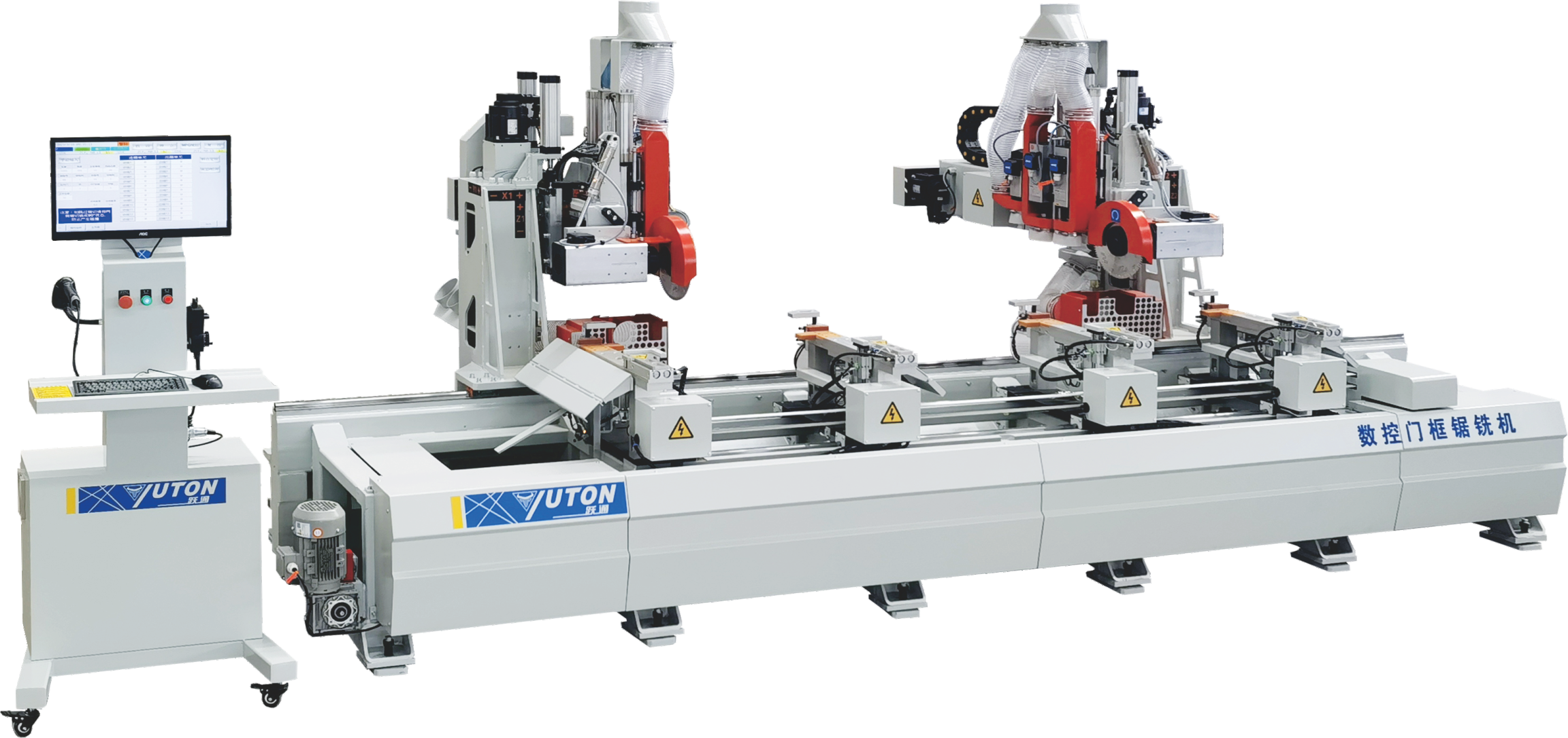
Door Frame Processing Equipment
Door frame processing equipment cuts and mills door frame profiles and architrave profiles. Documented models include:
- YD-K0330 CNC door frame cutting & milling machine
- MJK9045 CNC door frame cutting machine
- MJK9024K CNC door frame cutting & milling machine
- YD-K0330L CNC door frame & architrave cutting & milling machine
- MDZ565 door frame L-shape architrave splicing machine
Profile and Molding Processing Equipment
Profile equipment forms architrave, moulding and specialty profiles before they enter the door frame or casing process:
- YJ-T0230 CNC architrave cutting machine
- YH-T1030 CNC milling and folding molding machine
- MJK9002A CNC profile cutting machine
- MJK2740 splitting machine
- MDK6624J flexible continuous wood strip splicing and cutting machine
Multi-Function Machining Centers
For factories that need several operations completed at a single station, the multi-function machining center family covers the YX-S8026 multiple function machining center, the YD-S2030 CNC multiple function machining center, the MXK1224YAH machining center and the MXK0630D cabinet NC machine.
What an Automatic Door Assembly Machine Actually Processes
The workpiece envelope differs by model, and this is the specification most buyers should check first. Published parameters for three representative units are shown below.
| Machine | Workpiece length | Workpiece width | Workpiece thickness | Overall dimensions |
|---|---|---|---|---|
| YD-K0330 CNC door frame cutting & milling machine | 600–2,600 mm | 90–350 mm | 18–40 mm | 4,900 × 2,600 × 2,100 mm |
| MDK4120D CNC lock hole & hinge slot machine | 1,800–2,400 mm | 600–1,100 mm | 30–60 mm | 2,740 × 2,270 × 1,620 mm |
| YX-S8026 multiple function machining center | 1,600–2,600 mm | 280–1,200 mm | 30–60 mm | — |
The ranges explain how the machines are positioned on a floor. A frame machine with a wide envelope covers standard and oversized frames; a lock and hinge machine with a much narrower length band is built around standard door leaf heights.
How a Wood Door Automation Line Runs, Step by Step
Inside the equipment, operations run in a program-controlled sequence: sawing, milling, slotting and punching. At line level, those operations fall into six stages.
Step 1 — Profile and moulding preparation. Architrave and profile stock is cut, split and formed. The MJK2740 splitting machine handles splitting, the MJK9002A CNC profile cutting machine handles cut-to-length work, and the YH-T1030 CNC milling and folding molding machine produces the folded profile. L-shaped architrave joints are spliced on the MDZ565 door frame L-shape architrave splicing machine.
Step 2 — Door frame cutting and milling. Door frame stock is cut to length and milled. The YD-K0330, MJK9045, MJK9024K and YD-K0330L cover this station at different levels, depending on whether frames, architraves, or both, are being processed.
Step 3 — Door leaf sizing and squaring. Door leaves are cut to fixed length and squared, using the YJ-S0320D CNC door four edges saw.
Step 4 — Lock and hinge machining. Lock holes and hinge slots are cut on each leaf — the function served by the MDK4826Q2, MDK4130A1 and MDK4120D machines.
Step 5 — Seal strip insertion. The sealing strip is inserted on the MFZ9645H2 automatic seal strip inserting machine.
Step 6 — Integration. The stations can be combined into automated units or complete production lines. YUTON describes the product range as span automation single machines, automation units and automation production lines, each carrying flexible manufacturing capability for batch production and, on that basis, meeting the requirements of customised production.
Where These Machines Are Actually Used
The equipment serves the wooden door and window manufacturing industry and is built for manufacturers of wooden composite door leaves and door frames. It is also applied in whole-house customized furniture factories and wood processing enterprises.
Documented application scenarios include:
- Automated flexible production lines for civil household wooden doors
- Automated flexible production lines for engineering refined decoration wooden doors
- Batch production of door leaves and door frames with customised order variation
- Door component production inside whole-house customisation environments
The equipment is installed new in factory workshops on 220V or 380V supply, and is deployed under an intelligent manufacturing industrialization project model. In practice this usually means a door factory either automating processes inside an existing plant, or planning the equipment set for a new door production line from the ground up.
Compliance Requirements Before Door Machinery Ships to the EU
Wood door automation equipment carries cutting and forming tools, so the compliance burden is higher than it is for many other woodworking investments.
Under EU Machinery Directive 2006/42/EC, before machinery is placed on the market or put into service, the manufacturer or authorised representative must ensure that it satisfies the relevant essential health and safety requirements.
The same directive sets out requirements specific to machinery for working wood: the workpiece must be able to be placed and guided safely, risks from ejection must be controlled, and an automatic brake must be provided where contact with a running-down tool presents a risk.
Woodworking-specific safety standards carry this further:
- EN ISO 19085-1:2021 — common safety requirements for woodworking machines capable of continuous production use, covering significant hazards during operation, adjustment, maintenance, transport, assembly, dismantling, disabling and scrapping.
- EN 1870-16:2012 — combined woodworking machines capable of continuous production use with manual loading and unloading.
- HSE woodworking standards list — includes the BS EN 847 series for woodworking tools, plus BS EN 848, BS EN 859, BS EN 940, BS EN 1807, BS EN 1870, BS EN 12779 for fixed dust extraction systems, BS EN 13850 and BS EN ISO 13857 for safety distances.
Applicability of any individual standard depends on machine design, feed method, tooling and jurisdiction. Buyers should confirm which standard applies to each specific machine configuration rather than assuming one standard covers an entire line.
According to YUTON's own product documentation, its wood door automation machines have obtained CE certification complying with the 2006/42/EC Machinery Directive.
Comparing Door Processing Equipment by Function
| Equipment family | Representative models | Core function | Role in the factory |
|---|---|---|---|
| Door frame processing | YD-K0330, MJK9045, MJK9024K, YD-K0330L | Cutting and milling of door frames and architraves | Sets the frame profile before assembly |
| Door leaf hardware and sealing | MDK4826Q2, MDK4130A1, MDK4120D, MFZ9645H2 | Lock holes, hinge slots, seal strip insertion | Replaces repetitive manual hardware stations |
| Door leaf sawing | YJ-S0320D | Four-edge sawing and squaring of leaves | Fixed-length and squaring accuracy |
| Multi-function machining | YX-S8026, YD-S2030, MXK1224YAH, MXK0630D | Combined CNC operations at one station | Reduces handling between stations |
| Profile and moulding | YJ-T0230, YH-T1030, MJK9002A, MJK2740, MDZ565, MDK6624J | Architrave cutting, folding moulding, profile splitting and splicing | Feeds the frame and casing operations |
Frequently Asked Questions
What safety and compliance requirements apply to wood door automation equipment in the EU?
Woodworking machinery placed on the EU market or put into service must satisfy the essential health and safety requirements of Machinery Directive 2006/42/EC. Requirements specific to machinery for working wood cover safe placement and guidance of the workpiece, control of ejection risks, and an automatic brake where contact with a running-down tool presents a risk. EN ISO 19085-1:2021 defines common safety requirements for woodworking machines capable of continuous production use, and the HSE woodworking standards list includes BS EN 847, BS EN 848, BS EN 859, BS EN 940, BS EN 1807, BS EN 1870, BS EN 12779, BS EN 13850 and BS EN ISO 13857. Applicability varies by configuration. YUTON states that its wood door automation machines have obtained CE certification complying with the 2006/42/EC Machinery Directive.
What does an automatic door assembly machine actually process?
It performs CNC machining of wooden door leaves, door frames and panels — sawing, milling, slotting and punching — to complete the forming process of wooden door components. The covered work includes fixed-length cutting and squaring of door leaves, lock holes and hinge slots, seal strip insertion, door frame and architrave cutting and milling, and architrave and profile forming and splicing. Working envelopes differ by model: the YD-K0330 handles workpieces 600–2,600 mm long, 90–350 mm wide and 18–40 mm thick, while the YX-S8026 handles workpieces 1,600–2,600 mm long, 280–1,200 mm wide and 30–60 mm thick.
What configuration levels are available for wood door automation equipment?
YUTON structures the range as automation single machines, automation units and automation production lines. Each level carries flexible manufacturing capability for batch production and, on that basis, meets the requirements of customised production. Non-standard configuration is defined by the door leaf, door frame and profile processing applications rather than by a fixed model list, so the starting point for scope is the workpiece envelope and the number of stations a factory needs to cover.
Which factories are suited to automatic wood door processing equipment?
The equipment serves the wooden door and window manufacturing industry, including manufacturers of wooden composite door leaves and door frames. It is also applied in whole-house customized furniture factories and wood processing enterprises, and is designed for automated flexible production line scenarios covering civil household wooden doors and engineering refined decoration wooden doors. Typical installations are new machines in factory workshops on 220V or 380V supply, deployed under an intelligent manufacturing industrialization project.
What should buyers know about YUTON as a wooden door equipment supplier?
NANTONG YUETONG CNC EQUIPMENT CO.,LTD was established in 2003 and is a national high & new technology enterprise specialising in the research and development and manufacturing of automated wooden door production equipment, with over 20 years of experience in the category. The manufacturing facility covers 110,666.67 square meters with approximately 155 staff, an annual production capacity of 2,400 units and an R&D team of 55 engineers and technicians. Export accounts for roughly 70% of output, with equipment delivered to more than 50 countries including Russia, Ukraine, Czech Republic, Spain, Romania, Egypt, Vietnam, Japan, India, Israel, Saudi Arabia, United Arab Emirates, Singapore, Malaysia, United States, Canada, Brazil and Chile. YUTON developed a flexible wooden door production line in 2013 and reports 458 such lines sold to date. Buyers can request samples, drawings or a quotation through shanghai@yuetong.com.cn.
Conclusion
An automatic door assembly machine is a configuration decision, not a model number. Door leaf processing, door frame processing and profile processing each carry their own machine family, and a wooden door factory can automate station by station or build the whole set at once. In a market where machinery spending is projected to grow at 5.1% annually to 2035 while woodworker employment is projected to fall 2% by 2034, the relevant question for a buyer is which level of automation fits the current order mix — not whether automation is coming.
The practical sequence is straightforward: define the actual workpiece dimensions the line must cover, confirm which standards apply in the destination market, and then match machine families to the door types being produced.
Next Step
YUTON wooden door equipment covers door leaf processing, door frame processing and profile processing, supplied as automation single machines, units or complete production lines. To review the full model range, download the product catalogue or visit www.yuetong.com.cn. For equipment questions, sample discussion or a quotation, contact the team at shanghai@yuetong.com.cn or +86 139 1832 8385.
Have Questions or Need More Details?
Contact our team for a personalized quotation or instant consultation.
Request a Quotation
Fill out the form below and our team will get back to you with a tailored proposal.
WhatsApp Direct Chat
Prefer to chat in real-time? Message us on WhatsApp for instant assistance & quick answers.
- Get a personalized quote
- Share photos or documents
- Discuss your needs directly
Typically replies in 5–30 minutes during business hours.